Why is Soil Organic Carbon Variable across Global Soils?
Jan-11-2026
Understanding Soil Organic Carbon (SOC) variability and different measurement approaches for accurate carbon accounting and sustainable land management.
SOC Variability across Global Soils
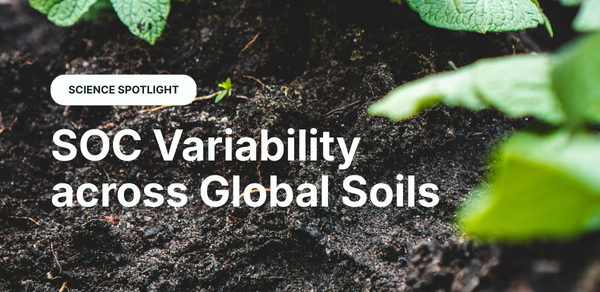
SOC is fundamental to soil health, agricultural productivity, and climate resilience. Yet SOC is far from uniform. It varies dramatically across continents, across landscapes, and even within a single field. SOC originates from biological inputs: root exudates, decomposing plant residues, and organic amendments such as manure. Once in the soil, this carbon is continually transformed, redistributed, and stabilised through a range of interacting processes. These processes operate at different spatial scales, which is why SOC can appear relatively uniform in some soils and highly patchy in others.
Key drivers of SOC Variability
- Biological activity and soil organisms
- Microbes, fungi, earthworms, and other soil fauna break down organic matter and move it through the soil profile or return it to the atmosphere. Farming practices and erosion can further redistribute carbon, creating hotspots and depleted zones.
- Soil microclimate
- Temperature and moisture regulate microbial decomposition. Warmer, wetter conditions accelerate breakdown, while cooler or drier soils slow it down. These microclimatic differences can occur over surprisingly short distances, even different parts of the same field.
- Soil chemistry and mineralogy
- Clay content, pH, and mineral composition influence how carbon binds to soil particles and how long it remains stable. Some soils protect carbon effectively; others allow it to decompose more readily.
Together, these factors create SOC distributions that vary over multiple length scales: in some landscapes, SOC changes gradually over kilometres, while in others, SOC can shift by an order of magnitude within a single metre. The lack of consistent spatial patterns is a major challenge for anyone trying to measure or model soil carbon accurately.
Different Approaches for Measuring Variability
A range of measurement techniques exist, each with strengths and limitations when confronted with SOC’s natural heterogeneity.
- Direct Soil Sampling
- Laboratory analysis of soil cores remains the most accurate way to measure SOC at a point. However, sampling is labour intensive and expensive at scale, and low density sampling often fails to capture within-field variability.
- Proximal Sensing
- Techniques such as electromagnetic (EM) induction or gamma radio metrics measure soil properties indirectly and at high resolution. These methods offer excellent field coverage and can highlight within field variability, but they require careful calibration to SOC measurements.
- Hybrid Approaches
- Combining targeted in‑situ sampling with remote or proximal sensing provides both accuracy and spatial completeness. This integrated approach is increasingly recognised as the most robust way to map SOC variability.
The Downforce Approach
Downforce Technologies combines in-situ and remote methods into a unified, scalable system designed to accurately capture SOC variability across lengthscales ranging from within-field to landscape or even landmass. Our platform builds on traditional soil measurement methods by integrating ground-based data and satellite observations to measure annual SOC levels from 2017 to the present day. We combine scientifically robust data with contextual understanding, to deliver actionable insights on the impact of land management practices on soil health.
How Downforce SOC data addresses variability
- High-resolution spatial insight
- By integrating earth observation data, topography, climate, and environmental variables, Downforce maps SOC variation at fine scales across entire landscapes. Our 10m resolution satellite observations allow us to see changes in SOC, whether across a farm or across a country.
- Advanced modelling
- Empirical models control for biological, chemical, and physical drivers of SOC, reflecting and accommodating the complexity of soil systems rather than relying on oversimplified assumptions.
- Targeted ground truthing
- Strategic soil sampling ensures robust calibration while avoiding the inefficiencies of blanket sampling.
- Scalable monitoring
- The approach works for individual fields to national scale assessments, enabling consistent and credible carbon accounting.
By embracing — rather than ignoring — the inherent variability of SOC, Downforce delivers more accurate carbon estimates and more meaningful insights. Empowered with these insights, farmers, landowners and supply chain companies can implement more sustainable agricultural solutions to drive farmer profitability, improve resilience and remove carbon from the atmosphere.
Connect with our team to learn more about our approach for delivering Soil Organic Carbon data: info@downforce.tech
Back To News