
Science explainer
Methodology
Reducing uncertainty in soil organic carbon measurement
Understanding uncertainty and the ways Downforce ensures accuracy in soil carbon measurement.
Soil carbon is one of the most powerful natural climate solutions but also one of the most variable. Soils differ across landscapes, seasons, and management systems, and the biological processes that govern carbon storage are inherently dynamic. This variability introduces uncertainty, but rather than being a weakness, it is a fundamental feature of natural systems. At Downforce, we treat uncertainty as a source of scientific strength.
What is uncertainty across global soils?
Uncertainty in soil carbon measurement arises because soils are shaped by complex, interacting processes that vary across space and time. In biogenic carbon systems — where carbon moves through living ecosystems — this uncertainty is not only expected but unavoidable.
Key drivers include:
Natural soil variability: Texture, mineralogy, moisture, and land-use history differ even within a single field.
Climate and weather: Rainfall, temperature, soil moisture, flooding, and drought influence carbon inputs and losses.
Biological processes: Plant growth, microbial activity, and decomposition fluctuate seasonally and annually.
Disturbance events: Fires, erosion, and extreme weather can rapidly alter carbon stocks.
Management practices: Tillage, grazing, cover cropping, and rotations interact with local conditions in non-linear ways.
These factors operate at multiple scales — from centimetres to continents, from days to decades. Because they cannot be fully predicted or controlled, uncertainty is an inherent part of any soil carbon assessment. Recognising and representing this uncertainty is essential for credible reporting.
Two complementary types of uncertainty
1. Qualitative uncertainty
Qualitative uncertainty describes where uncertainty comes from. It identifies potential sources of error or variability — such as data gaps, model assumptions, natural heterogeneity, or measurement constraints — and indicates whether their influence is likely low, moderate, or high. This helps users understand the nature of uncertainty, but it does not quantify its magnitude.
2. Quantitative uncertainty
Quantitative uncertainty assigns numerical values to uncertainty, allowing it to be measured, compared, and incorporated into reporting and assurance. This includes metrics such as standard deviation, confidence intervals, probability distributions and uncertainty ranges. Quantitative uncertainty is essential for demonstrating conservativeness, tracking change over time, and supporting verification.
Together, qualitative and quantitative uncertainty provide a complete picture: qualitative explains why uncertainty exists; quantitative shows how much it matters.
Reducing uncertainty in soil carbon measurement
When estimating soil carbon stocks or changes, uncertainty arises from multiple sources simultaneously. Downforce addresses each source explicitly.
1. Measured variability in soil carbon
Soil carbon naturally fluctuates across fields and over time. Downforce re-measures at 10 m intervals, every ten days, to obtain a true sense of the SOC variability. These measurements are analysed to ensure that reported changes reflect real, sustained gains — not short-term noise.
2. Model uncertainty
Models simplify complex biological processes and may not always capture local conditions. Downforce reduces this uncertainty by:
using empirical models grounded in remotely measurable variables
improving the identification of land management practices
calibrating models to local soil and climate conditions
3. Parameter uncertainty
Parameters such as bulk density, soil properties, and climate inputs influence model behaviour. Where direct uncertainty data are missing, Downforce applies conservative, science-based defaults to avoid underestimating uncertainty.
4. Scenario uncertainty
Different assumptions or management pathways can lead to different outcomes. Downforce represents uncertainty using normal distributions where empirically justified, ensuring that gains are only recognised when they exceed background variability.
Downforce’s UK SOC Data Layer
Downforce’s methodology combines multiple uncertainty sources using probability-based methods rather than relying on single point estimates. This ensures that uncertainty is calculated at fine spatial and temporal scales, propagated through the entire analysis and reflected transparently in final results. Where uncertainty is higher, results are interpreted conservatively to avoid overstating removals.
Downforce’s UK SOC Data Layer is designed for focussed fit — optimised for catchment and farm-level accuracy rather than global generalisation.
Key features include:
emphasis on mineral soils, arable, and pasture systems
separate treatment for peatlands, where depth loss and peatland health require distinct modelling
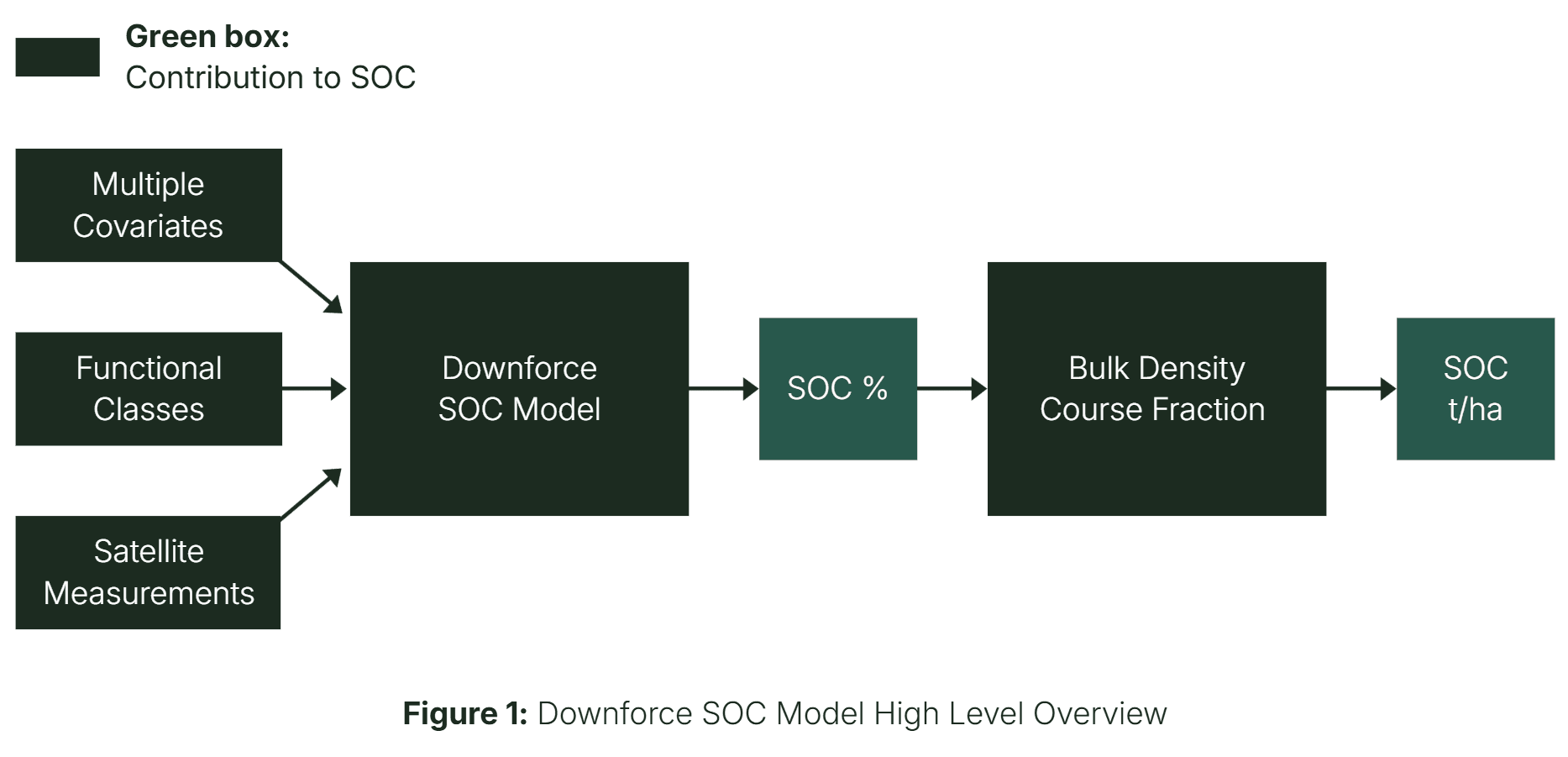
integration of: parameter base layers (multiple covariates that are known to be physically related to SOC, e.g. climate, land use/cover, terrain, bulk density, coarse fraction, and historic soil samples)
satellite measurements varying through space and time
Downforce proprietary SOC Model processes, including regression selection and parameter computation
Uncertainty is a reflection of the natural world. When quantified rigorously and communicated clearly, uncertainty becomes a strength by enhancing scientific integrity, supporting conservative, defensible carbon accounting and guiding smarter land management. Downforce is committed to delivering soil carbon insights that are accurate, transparent, and grounded in the complexity of global soils — because confidence grows from understanding how to measure natural systems, not from pretending uncertainty doesn’t exist.